


How to Dispute Credit Report Errors in Texas: Complete FCRA Guide
In Texas, you have the right under federal and state law to dispute wrong credit report items. Credit bureaus must usually investigate within 30 days for free, and they must remove or correct anything they cannot verify.
If you’ve ever stared at a wrong item on your credit report and felt powerless, you’re not alone. Most Texans don’t realize how strong their legal protections actually are.
Here’s the truth nobody hands you: you have more rights than the credit bureaus would like you to know. Federal law gives you teeth. Texas state law adds more. And when they break the rules — which happens — there are real consequences.
This is the empowerment guide. We’ll walk through:
- Your federal rights under the Fair Credit Reporting Act (FCRA), in plain English
- Your Texas-specific protections most people don’t know about
- What credit bureaus and creditors MUST do (and what it costs them when they don’t)
- The underused right to add your own statement to your file
- How to escalate when the bureau ignores you
- When credit repair pros, attorneys, or government agencies make sense
One quick note: this is educational information, not legal advice. For questions about your specific case, consult a Texas consumer law attorney.
You have more rights than you think
Two layers of law protect you when your credit report is wrong and you need to dispute credit report errors in Texas:
- Federal law (the Fair Credit Reporting Act, or FCRA) — applies in every state
- Texas state law — adds extra protection on top, including the Texas Business and Commerce Code and the Texas Deceptive Trade Practices Act
Most Texans never realize the second layer exists. Credit bureaus and collectors definitely don’t go out of their way to remind you.
Your federal rights under the FCRA
The Fair Credit Reporting Act is the main federal law governing credit reports. Here are the rights it gives you, stripped of legalese.
1. Your Right to Dispute Credit Report Errors (FCRA Section 611)
If you believe any item on your credit report is wrong, incomplete, or unverifiable, you have the right to dispute it. When you dispute credit report errors in Texas, the law requires bureaus to investigate. The bureau cannot charge you. There’s no limit to how many items you can dispute, and no limit to how many times you can file a dispute.
2. The right to a real investigation within 30 days
Credit bureaus must investigate your dispute within 30 days. This can extend to 45 days if you send additional documents during the review. If the bureau cannot verify the item, it must be corrected or removed.
This is the rule with teeth. A “reasonable reinvestigation” is required by law — not a rubber stamp.
3. The right to demand the “method of verification”
If the bureau says “we verified this,” you have the right to ask exactly HOW. They must tell you within 15 days. If they can’t explain a real verification process, that’s a violation.
This is one of the most underused rights in credit reporting law.
4. The right to free credit reports
You can pull one free credit report from each of the three bureaus every year at AnnualCreditReport.com. Many people don’t realize this. Getting all three takes time and the reports come in dense formats, which is why we recommend CheckYourCreditReports.com for ongoing monitoring — it pulls all three into one clean dashboard for a small monthly fee.
5. The right to add a consumer statement to your file
If a dispute does not go your way but you still believe something is wrong, you have the right to add a 100-word statement to your credit report explaining your side. We’ll cover this in more detail below — it’s an underused tool.
6. The right to sue when they violate the law
Yes, really. If a credit bureau or creditor willfully or negligently violates the FCRA, you can sue them. Damages can include actual losses, statutory damages, and attorney fees. We’ll get into this further down.
Ready to get back on track?
Get Your Free Credit Analysis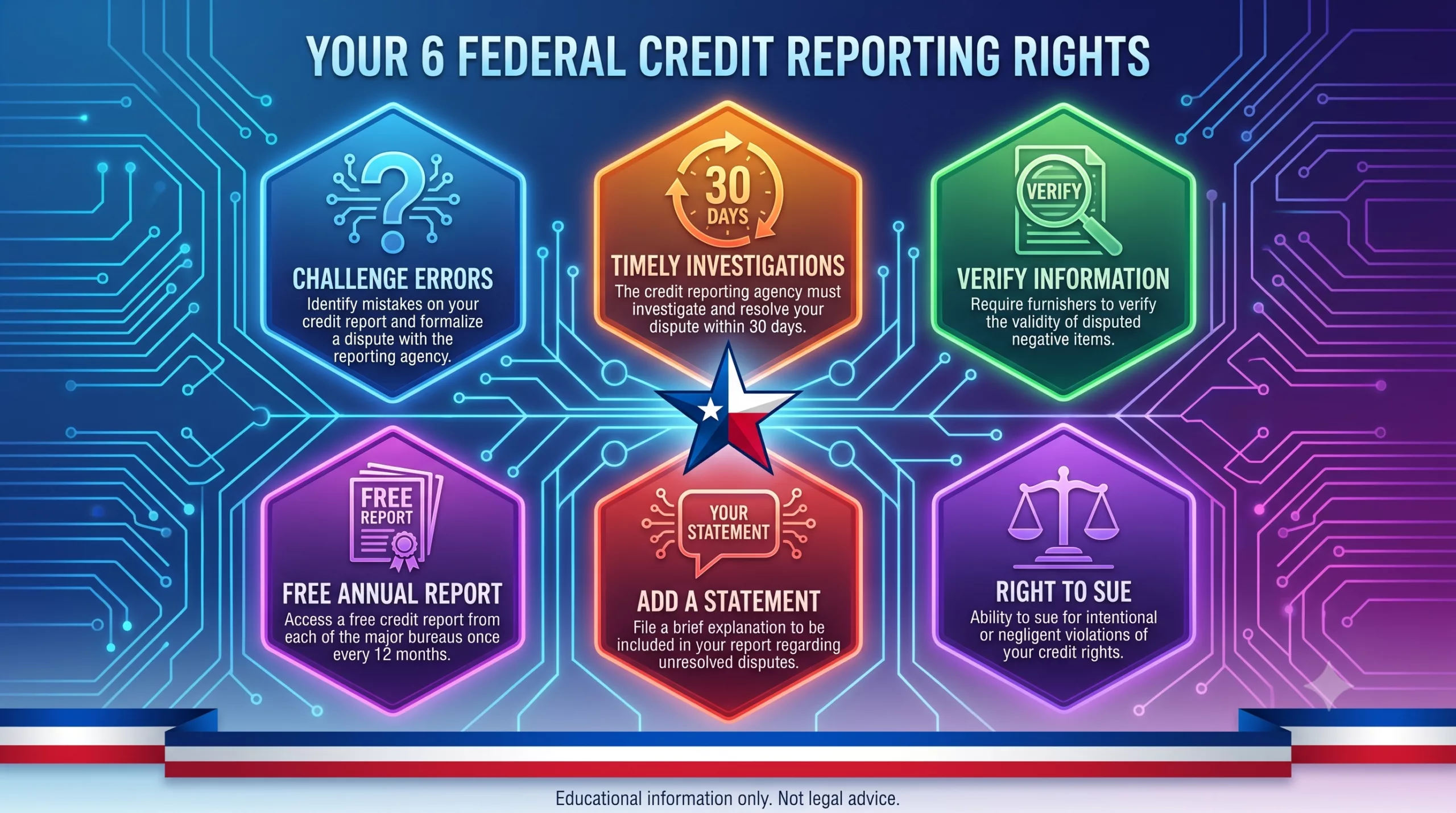
Your Texas-specific protections
This is where Texans get an extra layer most consumers in other states don’t have.
Texas Business and Commerce Code
Texas has its own credit reporting rules built into state law. These rules cover what credit bureaus and creditors operating in Texas can and cannot do. They mirror the FCRA in most ways, but Texas adds enforcement power through the state Attorney General.
Key Texas protection: creditors and collectors doing business in Texas must follow both federal AND state rules. They cannot duck Texas law by claiming “we’re a federal-only operation.”
The Texas Deceptive Trade Practices Act (DTPA)
The DTPA is one of the strongest consumer protection laws in the country. It applies when a business in Texas uses false, misleading, or unconscionable acts that harm a consumer.
Credit-related DTPA violations can include things like:
- Knowingly reporting false information about a consumer
- Refusing to fix verified errors
- Misrepresenting the status of a debt
- Deceptive collection practices that affect credit reporting
The DTPA is complex, and the specific tests for a successful claim are best handled by a Texas consumer law attorney. But knowing the law exists is the first step. Many Texans give up too early because they don’t know they have a state-level option on top of federal law.
The Texas Attorney General as your backup
If a credit bureau or collector breaks the law in Texas, you can file a complaint with the Texas Attorney General’s office. The AG handles consumer protection complaints and can take action against companies that consistently violate consumer rights.
Filing a complaint with the AG is free, takes about 15 minutes online, and creates a public record. Companies often respond faster to AG complaints than to direct consumer disputes.
The 4-year statute of limitations on debts
Texas has one of the shorter statutes of limitations in the country on most consumer debts — 4 years. After that, the collector cannot legally sue you for the debt.
Important warning: a verbal “promise to pay” or even a small partial payment can restart this clock. We covered this in detail in our guide on handling collections before a Texas mortgage. If a collector calls about an old debt, do not agree to pay anything until you know how old the debt is and whether the statute has passed.
Ready to get back on track?
Get Your Free Credit AnalysisWhat credit bureaus and creditors MUST do (and what happens if they don’t)
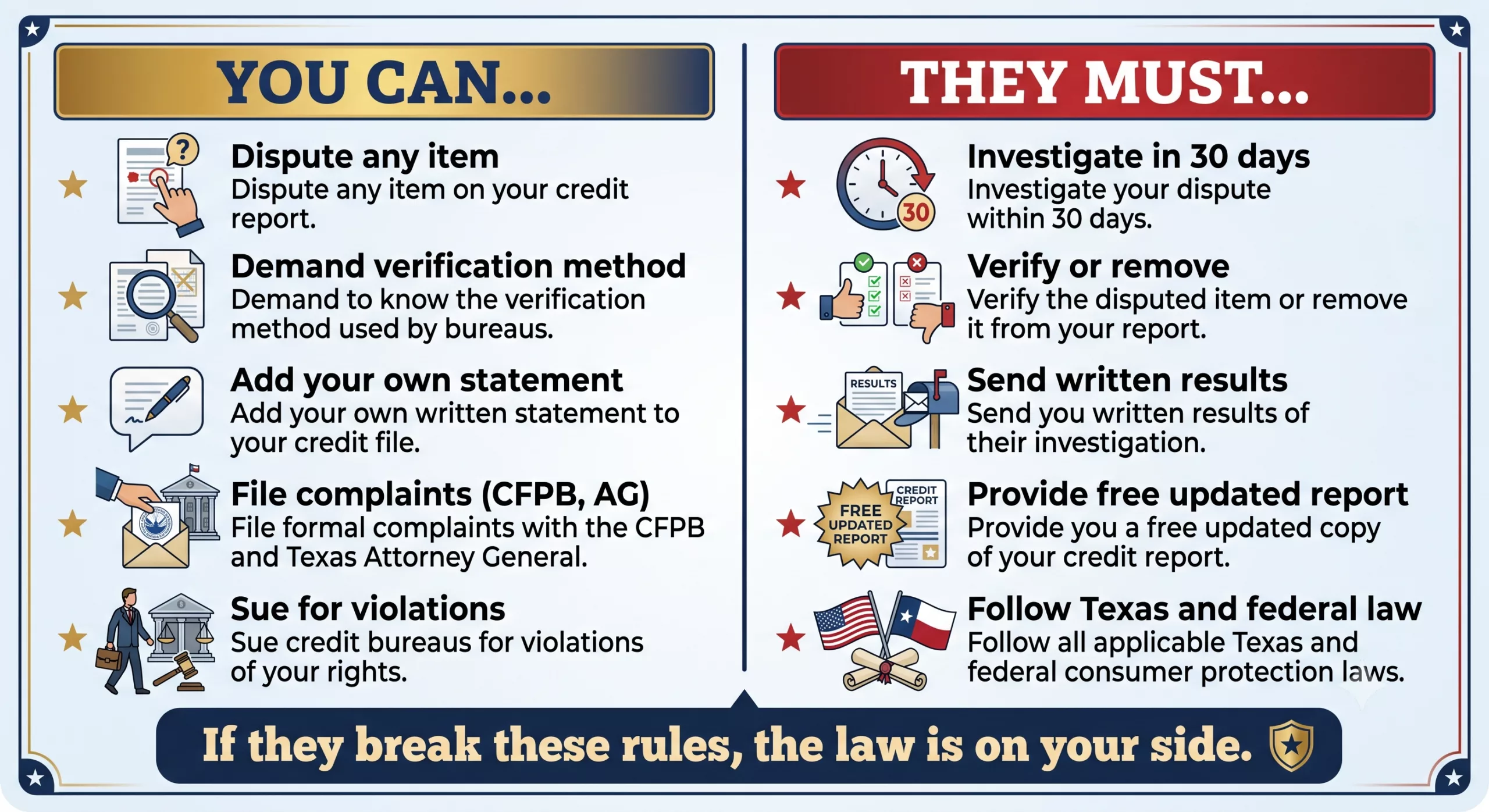
Under federal and Texas law, when you dispute something, here’s what’s required:
- Investigate within 30 days (or 45 if you send extra documents)
- Contact the original creditor and ask them to verify the item
- Remove or correct any item they cannot verify
- Send you the results in writing within 5 business days of completing the investigation
- Provide a free updated credit report if changes were made
- Add the “consumer disputes” notation to the account if the dispute continues
These are not suggestions. They’re legal requirements.
What it costs them when they violate
If a credit bureau or creditor breaks these rules, the law has teeth:
- Negligent violations: The consumer can recover actual damages plus attorney fees
- Willful violations: Actual damages OR statutory damages between $100 and $1,000, plus punitive damages, plus attorney fees
- Class action exposure: Repeat violations against many consumers can trigger class action lawsuits with massive payouts
This is why many consumer law attorneys take FCRA cases on contingency — meaning you pay nothing unless you win. The law is structured to make these violations expensive for the bureaus, which gives the rules real enforcement power.
That said, suing is not the first move for most people. Most disputes get resolved without legal action. But knowing the option exists changes how seriously bureaus and creditors take your dispute.
How to add Your statement to your credit file (the underused right)
This is one of the most overlooked tools in your toolbox.
If you dispute an item and the bureau still verifies it, you have the right under federal law to add a consumer statement to dispute credit report errors. This statement (usually limited to about 100 words) becomes part of your credit report and appears whenever a lender pulls your file.
When a consumer statement helps
- After a dispute was denied but you still believe the item is wrong
- When unique circumstances explain a negative item (job loss, medical emergency, identity theft)
- When the item is technically accurate but misleading without context
When a consumer statement does NOT help
- For obvious wins (just dispute and remove the item)
- For items that are clearly your fault (a statement does not change your score)
- As a substitute for actually disputing — always exhaust the dispute first
How to add one
Each of the three bureaus has a process for adding a consumer statement, usually through their dispute portals or by mail. Keep it short, factual, and unemotional. Lenders read these. Avoid blaming language — just state the facts you want them to know.
Important: a consumer statement does NOT change your credit score. It only adds context that a human reviewer might see during a manual underwrite.
When the bureau ignores you: how to escalate
If you’ve disputed an item and the bureau is dragging its feet or rubber-stamping a “verified” response without doing real work, you have several escalation paths.
1. The CFPB complaint portal
The Consumer Financial Protection Bureau (CFPB) takes complaints about credit bureaus and creditors. File at consumerfinance.gov.
Honest take from us: the CFPB used to be more effective than it is now. Funding and enforcement have been inconsistent in recent years, and outcomes can vary. But the complaint portal is still free, still creates a public record, and often gets a response from the bureau within a few weeks. It’s worth doing.
2. The Texas Attorney General
The Texas AG’s office takes consumer complaints, including credit reporting issues. Companies operating in Texas often respond faster to AG complaints than to direct consumer disputes, because the AG can launch an investigation or take action.
3. A consumer law attorney
For repeat or willful violations, a consumer law attorney can file an FCRA lawsuit. Many take these cases on contingency. The attorney fees provision in the FCRA means consumers can often pursue legal action without paying anything out of pocket.
4. A credit repair professional
Sometimes the issue isn’t a legal violation — it’s just that the dispute process is being handled poorly. A credit repair team that does this every day knows which strategies and language work with each bureau. We’ve found that what doesn’t work for a DIY consumer often works when handled the right way by someone who knows the system.
If your credit issues are blocking a home purchase, also check our guide on what to do after being denied for a mortgage in Texas.
Common questions about Texas credit report rights
What credit bureaus and creditors MUST do (and what happens if they don’t)
Under federal and Texas law, when you dispute something, here’s what’s required:
- Investigate within 30 days (or 45 if you send extra documents)
- Contact the original creditor and ask them to verify the item
- Remove or correct any item they cannot verify
- Send you the results in writing within 5 business days of completing the investigation
- Provide a free updated credit report if changes were made
- Add the “consumer disputes” notation to the account if the dispute continues
These are not suggestions. They’re legal requirements.
What it costs them when they violate
If a credit bureau or creditor breaks these rules, the law has teeth:
- Negligent violations: The consumer can recover actual damages plus attorney fees
- Willful violations: Actual damages OR statutory damages between $100 and $1,000, plus punitive damages, plus attorney fees
- Class action exposure: Repeat violations against many consumers can trigger class action lawsuits with massive payouts
This is why many consumer law attorneys take FCRA cases on contingency — meaning you pay nothing unless you win. The law is structured to make these violations expensive for the bureaus, which gives the rules real enforcement power.
That said, suing is not the first move for most people. Most disputes get resolved without legal action. But knowing the option exists changes how seriously bureaus and creditors take your dispute.
How to add Your statement to your credit file (the underused right)
This is one of the most overlooked tools in your toolbox.
If you dispute an item and the bureau still verifies it, you have the right under federal law to add a consumer statement to dispute credit report errors. This statement (usually limited to about 100 words) becomes part of your credit report and appears whenever a lender pulls your file.
When a consumer statement helps
- After a dispute was denied but you still believe the item is wrong
- When unique circumstances explain a negative item (job loss, medical emergency, identity theft)
- When the item is technically accurate but misleading without context
When a consumer statement does NOT help
- For obvious wins (just dispute and remove the item)
- For items that are clearly your fault (a statement does not change your score)
- As a substitute for actually disputing — always exhaust the dispute first
How to add one
Each of the three bureaus has a process for adding a consumer statement, usually through their dispute portals or by mail. Keep it short, factual, and unemotional. Lenders read these. Avoid blaming language — just state the facts you want them to know.
Important: a consumer statement does NOT change your credit score. It only adds context that a human reviewer might see during a manual underwrite.
When the bureau ignores you: how to escalate
If you’ve disputed an item and the bureau is dragging its feet or rubber-stamping a “verified” response without doing real work, you have several escalation paths.
1. The CFPB complaint portal
The Consumer Financial Protection Bureau (CFPB) takes complaints about credit bureaus and creditors. File at consumerfinance.gov.
Honest take from us: the CFPB used to be more effective than it is now. Funding and enforcement have been inconsistent in recent years, and outcomes can vary. But the complaint portal is still free, still creates a public record, and often gets a response from the bureau within a few weeks. It’s worth doing.
2. The Texas Attorney General
The Texas AG’s office takes consumer complaints, including credit reporting issues. Companies operating in Texas often respond faster to AG complaints than to direct consumer disputes, because the AG can launch an investigation or take action.
3. A consumer law attorney
For repeat or willful violations, a consumer law attorney can file an FCRA lawsuit. Many take these cases on contingency. The attorney fees provision in the FCRA means consumers can often pursue legal action without paying anything out of pocket.
4. A credit repair professional
Sometimes the issue isn’t a legal violation — it’s just that the dispute process is being handled poorly. A credit repair team that does this every day knows which strategies and language work with each bureau. We’ve found that what doesn’t work for a DIY consumer often works when handled the right way by someone who knows the system.
If your credit issues are blocking a home purchase, also check our guide on what to do after being denied for a mortgage in Texas.
Common questions about Texas credit report rights
Both. Credit bureaus and creditors operating in Texas must follow federal law (the FCRA) AND Texas state law (the Texas Business and Commerce Code and DTPA). Companies cannot ignore Texas law by claiming they only follow federal rules. The Texas Attorney General can take action against companies that violate state consumer protection laws.
It depends on the violation type and the harm caused. For negligent violations, consumers can recover actual damages plus attorney fees. For willful violations, statutory damages range from $100 to $1,000 per violation, plus punitive damages, plus attorney fees. Actual recovery varies widely based on the specific case. A consumer law attorney can evaluate your situation.
The Texas DTPA is a strong consumer protection law that applies when a business uses false, misleading, or unconscionable practices that harm a consumer. It can apply to credit reporting in cases like knowingly false reporting, refusal to fix verified errors, or deceptive collection practices. DTPA claims are complex and best evaluated by a Texas consumer law attorney.
Yes. Under federal law, you have the right to add a brief consumer statement (typically up to 100 words) to your credit report. This statement appears on your file and is visible to lenders who pull your report. It does not change your credit score, but it can provide context for unique circumstances. Each of the three bureaus has a process for adding a consumer statement.
Yes. Under the federal Fair Credit Reporting Act, consumers can sue credit bureaus or creditors who willfully or negligently violate the law. Damages can include actual losses, statutory damages between $100 and $1,000 for willful violations, punitive damages, and attorney fees. Many consumer law attorneys take FCRA cases on contingency, meaning you pay nothing unless you win.
Yes. Credit repair is legal in Texas and across the United States, regulated by the federal Credit Repair Organizations Act (CROA) and Texas state law. Reputable credit repair companies cannot charge upfront fees, must provide written contracts with a 3-day right to cancel, and cannot promise specific score increases or guarantee removal of accurate information.
In Texas, you have the right under federal and state law to dispute wrong credit report items. Credit bureaus must usually investigate within 30 days for free, and they must remove or correct anything they cannot verify.
If you’ve ever stared at a wrong item on your credit report and felt powerless, you’re not alone. Most Texans don’t realize how strong their legal protections actually are.
Here’s the truth nobody hands you: you have more rights than the credit bureaus would like you to know. Federal law gives you teeth. Texas state law adds more. And when they break the rules — which happens — there are real consequences.
This is the empowerment guide. We’ll walk through:
- Your federal rights under the Fair Credit Reporting Act (FCRA), in plain English
- Your Texas-specific protections most people don’t know about
- What credit bureaus and creditors MUST do (and what it costs them when they don’t)
- The underused right to add your own statement to your file
- How to escalate when the bureau ignores you
- When credit repair pros, attorneys, or government agencies make sense
One quick note: this is educational information, not legal advice. For questions about your specific case, consult a Texas consumer law attorney.
You have more rights than you think
Two layers of law protect you when your credit report is wrong:
- Federal law (the Fair Credit Reporting Act, or FCRA) — applies in every state
- Texas state law — adds extra protection on top, including the Texas Business and Commerce Code and the Texas Deceptive Trade Practices Act
Most Texans never realize the second layer exists. Credit bureaus and collectors definitely don’t go out of their way to remind you.
Your federal rights under the FCRA
The Fair Credit Reporting Act is the main federal law governing credit reports. Here are the rights it gives you, stripped of legalese.
1. The right to dispute anything
If you believe any item on your credit report is wrong, incomplete, or unverifiable, you have the right to dispute it. The bureau cannot charge you. There’s no limit to how many things you can dispute, and no limit to how many times.
2. The right to a real investigation within 30 days
Credit bureaus must investigate your dispute within 30 days. This can extend to 45 days if you send additional documents during the review. If the bureau cannot verify the item, it must be corrected or removed.
This is the rule with teeth. A “reasonable reinvestigation” is required by law — not a rubber stamp.
3. The right to demand the “method of verification”
If the bureau says “we verified this,” you have the right to ask exactly HOW. They must tell you within 15 days. If they can’t explain a real verification process, that’s a violation.
This is one of the most underused rights in credit reporting law.
4. The right to free credit reports
You can pull one free credit report from each of the three bureaus every year at AnnualCreditReport.com. Many people don’t realize this. Getting all three takes time and the reports come in dense formats, which is why we recommend CheckYourCreditReports.com for ongoing monitoring — it pulls all three into one clean dashboard for a small monthly fee.
5. The right to add a consumer statement to your file
If a dispute does not go your way but you still believe something is wrong, you have the right to add a 100-word statement to your credit report explaining your side. We’ll cover this in more detail below — it’s an underused tool.
6. The right to sue when they violate the law
Yes, really. If a credit bureau or creditor willfully or negligently violates the FCRA, you can sue them. Damages can include actual losses, statutory damages, and attorney fees. We’ll get into this further down.
Ready to get back on track?
Get Your Free Credit AnalysisYour Texas-specific protections
This is where Texans get an extra layer most consumers in other states don’t have.
Texas Business and Commerce Code
Texas has its own credit reporting rules built into state law. These rules cover what credit bureaus and creditors operating in Texas can and cannot do. They mirror the FCRA in most ways, but Texas adds enforcement power through the state Attorney General.
Key Texas protection: creditors and collectors doing business in Texas must follow both federal AND state rules. They cannot duck Texas law by claiming “we’re a federal-only operation.”
The Texas Deceptive Trade Practices Act (DTPA)
The DTPA is one of the strongest consumer protection laws in the country. It applies when a business in Texas uses false, misleading, or unconscionable acts that harm a consumer.
Credit-related DTPA violations can include things like:
- Knowingly reporting false information about a consumer
- Refusing to fix verified errors
- Misrepresenting the status of a debt
- Deceptive collection practices that affect credit reporting
The DTPA is complex, and the specific tests for a successful claim are best handled by a Texas consumer law attorney. But knowing the law exists is the first step. Many Texans give up too early because they don’t know they have a state-level option on top of federal law.
The Texas Attorney General as your backup
If a credit bureau or collector breaks the law in Texas, you can file a complaint with the Texas Attorney General’s office. The AG handles consumer protection complaints and can take action against companies that consistently violate consumer rights.
Filing a complaint with the AG is free, takes about 15 minutes online, and creates a public record. Companies often respond faster to AG complaints than to direct consumer disputes.
The 4-year statute of limitations on debts
Texas has one of the shorter statutes of limitations in the country on most consumer debts — 4 years. After that, the collector cannot legally sue you for the debt.
Important warning: a verbal “promise to pay” or even a small partial payment can restart this clock. We covered this in detail in our guide on handling collections before a Texas mortgage. If a collector calls about an old debt, do not agree to pay anything until you know how old the debt is and whether the statute has passed.
Ready to get back on track?
Get Your Free Credit AnalysisWhat credit bureaus and creditors MUST do (and what happens if they don’t)
Under federal and Texas law, when you dispute something, here’s what’s required:
- Investigate within 30 days (or 45 if you send extra documents)
- Contact the original creditor and ask them to verify the item
- Remove or correct any item they cannot verify
- Send you the results in writing within 5 business days of completing the investigation
- Provide a free updated credit report if changes were made
- Add the “consumer disputes” notation to the account if the dispute continues
These are not suggestions. They’re legal requirements.
What it costs them when they violate
If a credit bureau or creditor breaks these rules, the law has teeth:
- Negligent violations: The consumer can recover actual damages plus attorney fees
- Willful violations: Actual damages OR statutory damages between $100 and $1,000, plus punitive damages, plus attorney fees
- Class action exposure: Repeat violations against many consumers can trigger class action lawsuits with massive payouts
This is why many consumer law attorneys take FCRA cases on contingency — meaning you pay nothing unless you win. The law is structured to make these violations expensive for the bureaus, which gives the rules real enforcement power.
That said, suing is not the first move for most people. Most disputes get resolved without legal action. But knowing the option exists changes how seriously bureaus and creditors take your dispute.
How to add YOUR statement to your credit file (the underused right)
This is one of the most overlooked tools in your toolbox.
If you dispute an item and the bureau still verifies it, you have the right under federal law to add a brief consumer statement to your file. This statement (usually limited to about 100 words) becomes part of your credit report and appears whenever a lender pulls your file.
When a consumer statement helps
- After a dispute was denied but you still believe the item is wrong
- When unique circumstances explain a negative item (job loss, medical emergency, identity theft)
- When the item is technically accurate but misleading without context
When a consumer statement does NOT help
- For obvious wins (just dispute and remove the item)
- For items that are clearly your fault (a statement does not change your score)
- As a substitute for actually disputing — always exhaust the dispute first
How to add one
Each of the three bureaus has a process for adding a consumer statement, usually through their dispute portals or by mail. Keep it short, factual, and unemotional. Lenders read these. Avoid blaming language — just state the facts you want them to know.
Important: a consumer statement does NOT change your credit score. It only adds context that a human reviewer might see during a manual underwrite.
When the bureau ignores you: how to escalate
If you’ve disputed an item and the bureau is dragging its feet or rubber-stamping a “verified” response without doing real work, you have several escalation paths.
1. The CFPB complaint portal
The Consumer Financial Protection Bureau (CFPB) takes complaints about credit bureaus and creditors. File at consumerfinance.gov.
Honest take from us: the CFPB used to be more effective than it is now. Funding and enforcement have been inconsistent in recent years, and outcomes can vary. But the complaint portal is still free, still creates a public record, and often gets a response from the bureau within a few weeks. It’s worth doing.
2. The Texas Attorney General
The Texas AG’s office takes consumer complaints, including credit reporting issues. Companies operating in Texas often respond faster to AG complaints than to direct consumer disputes, because the AG can launch an investigation or take action.
3. A consumer law attorney
For repeat or willful violations, a consumer law attorney can file an FCRA lawsuit. Many take these cases on contingency. The attorney fees provision in the FCRA means consumers can often pursue legal action without paying anything out of pocket.
4. A credit repair professional
Sometimes the issue isn’t a legal violation — it’s just that the dispute process is being handled poorly. A credit repair team that does this every day knows which strategies and language work with each bureau. We’ve found that what doesn’t work for a DIY consumer often works when handled the right way by someone who knows the system.
If your credit issues are blocking a home purchase, also check our guide on what to do after being denied for a mortgage in Texas.
Common questions about Texas credit report rights
Both. Credit bureaus and creditors operating in Texas must follow federal law (the FCRA) AND Texas state law (the Texas Business and Commerce Code and DTPA). Companies cannot ignore Texas law by claiming they only follow federal rules. The Texas Attorney General can take action against companies that violate state consumer protection laws.
It depends on the violation type and the harm caused. For negligent violations, consumers can recover actual damages plus attorney fees. For willful violations, statutory damages range from $100 to $1,000 per violation, plus punitive damages, plus attorney fees. Actual recovery varies widely based on the specific case. A consumer law attorney can evaluate your situation.
The Texas DTPA is a strong consumer protection law that applies when a business uses false, misleading, or unconscionable practices that harm a consumer. It can apply to credit reporting in cases like knowingly false reporting, refusal to fix verified errors, or deceptive collection practices. DTPA claims are complex and best evaluated by a Texas consumer law attorney.
Yes. Under federal law, you have the right to add a brief consumer statement (typically up to 100 words) to your credit report. This statement appears on your file and is visible to lenders who pull your report. It does not change your credit score, but it can provide context for unique circumstances. Each of the three bureaus has a process for adding a consumer statement.
Yes. Under the federal Fair Credit Reporting Act, consumers can sue credit bureaus or creditors who willfully or negligently violate the law. Damages can include actual losses, statutory damages between $100 and $1,000 for willful violations, punitive damages, and attorney fees. Many consumer law attorneys take FCRA cases on contingency, meaning you pay nothing unless you win.
Yes. Credit repair is legal in Texas and across the United States, regulated by the federal Credit Repair Organizations Act (CROA) and Texas state law. Reputable credit repair companies cannot charge upfront fees, must provide written contracts with a 3-day right to cancel, and cannot promise specific score increases or guarantee removal of accurate information.
Still not sure where to start?
Call us — we'll review all 3 of your credit reports for free and walk you through exactly what needs to happen.
Call (210) 520-0444