

Mortgage With Collections in Texas: Get Approved Despite Collections
Yes, you can often get a Texas mortgage with collections on your credit report. The type of collection matters more than the balance — medical collections rarely stop a mortgage, while student loan collections can block approval even with a great score.
If you have collections on your credit report and you want to buy a home in Texas, you are probably nervous. Most people in your spot think the same thing: “I blew my chance.”
Take a breath. You probably did not.
Here is the truth nobody tells you: not all collections are created equal. A $4,000 medical bill in collections will usually not stop a Texas mortgage. A $1,200 defaulted student loan can stop it cold — even if your score is 720. And how you handle a collection BEFORE you apply matters more than whether you pay it off at all.
This guide walks through what 15 years of working with Texas home buyers has taught us:
- The three types of collections and why they hit your mortgage chances very differently
- Why medical collections rarely matter (and when they do)
- Why student loan collections are the deal-killer most people miss
- The “middle-score rule” most Texas buyers do not know about
- Why paying off a collection the wrong way can hurt you before you apply
- When to bring in a professional before you make a move
The 3 types of collections — and why they are NOT all the same
When a lender sees a collection on your report, the first thing they ask is not “how much?” It is “what kind?”
There are three big categories, and each one carries its own weight in a Texas mortgage decision:
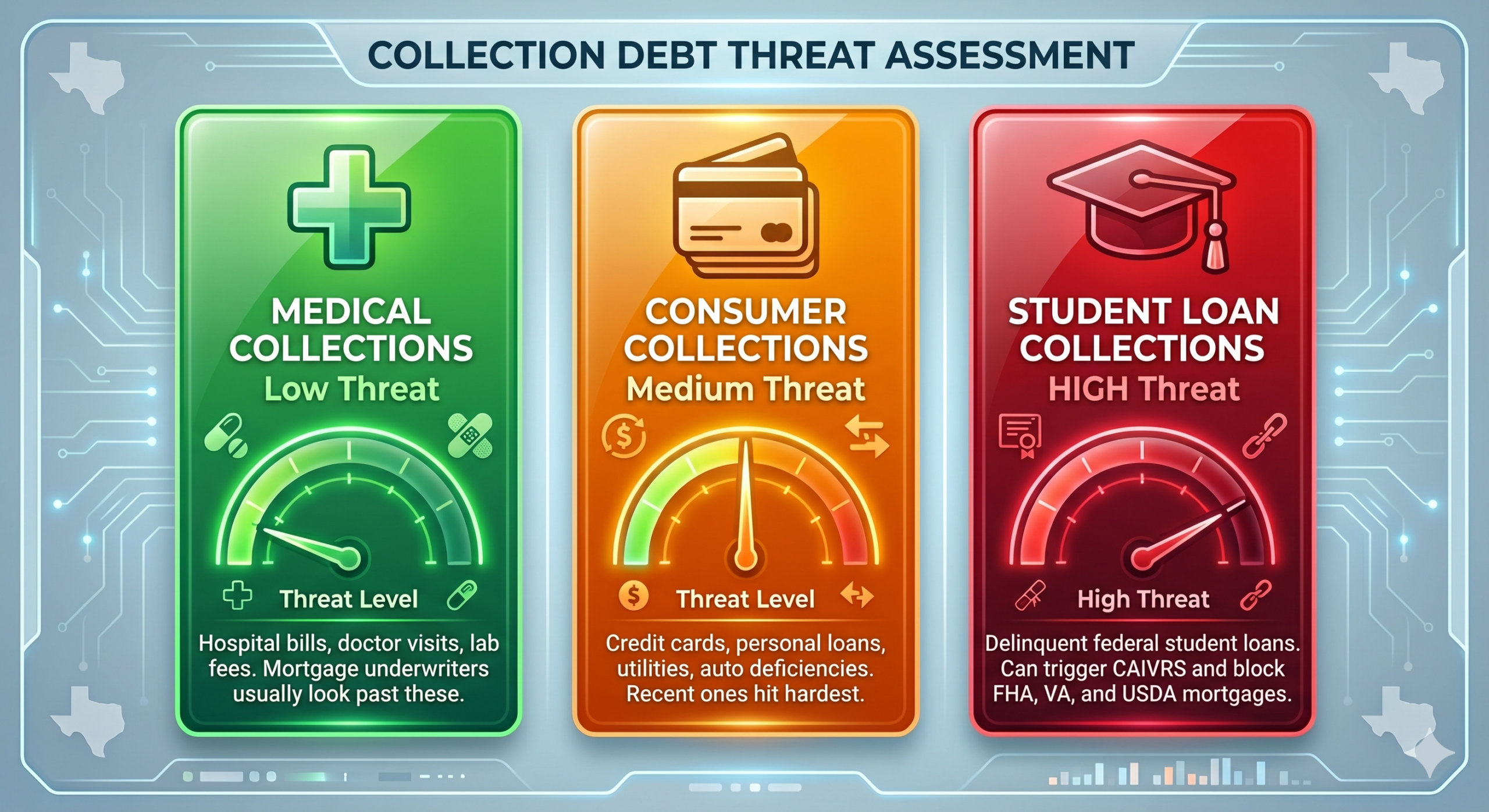
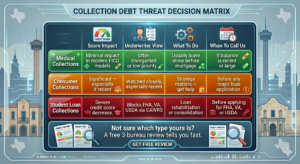
- Medical collections — the least scary, often ignored
- Consumer collections — credit cards, car loans, utilities — where real risk lives
- Student loan collections (federal) — the silent deal-killer
Let’s break each one down.
Medical collections (the least scary)
If your collection is from a hospital, doctor, lab, or other medical provider, breathe a little easier.
Medical collections rarely stop a Texas mortgage. Here is why:
- Modern FICO models heavily discount medical collections. FICO 9 and FICO 10 ignore medical collections under $100 entirely, and weight larger medical collections far less than other types.
- Mortgage underwriters know this. Even when an older mortgage FICO model still shows the hit, underwriters are trained to look past medical debt because everyone understands the medical system is broken.
- Recent rule changes have made it even harder to report medical debt. Many medical collections under $500 are now removed from credit reports automatically, and the regulatory environment continues to limit what can be reported.
When medical collections still matter
Medical collections are usually fine, but watch out when:
- The balance is very large (think $10,000+) and recent
- The collection is from a third-party debt buyer instead of the original hospital — these get reported more like consumer collections
- You are applying for a loan where the older FICO 2/4/5 mortgage models are pulled and have not been updated
- The medical debt has been mixed with other unpaid balances on the same account
For most Texas buyers in Houston, Dallas, San Antonio, and Austin, an old medical collection is not the thing that will sink your loan. Do not panic about it. Do not rush to pay it before talking to someone — sometimes paying it off can make things worse, not better. More on that in a minute.
Got collections on your report and a mortgage on your mind?
Ready to get back on track?
Get Your Free Credit AnalysisConsumer collections (the ones underwriters actually watch)
This is where it gets more serious.
Consumer collections include:
- Credit card debt that was charged off and sold to a collector
- Personal loans in collections
- Auto loan deficiencies after a repossession
- Old utility bills (electric, gas, phone, cable)
- Apartment deficiencies after a broken lease
- “Buy now, pay later” accounts that went unpaid
Unlike medical, these are treated as real financial mismanagement by mortgage underwriters. Here is what hurts most:
- Recent collections hit hardest. A consumer collection within the last 12 months is a much bigger red flag than one from 4 years ago.
- Multiple consumer collections show a pattern. One is a story. Three is a problem.
- Large balances — anything over $1,000 — pull more attention.
- Unresolved collections (still showing a balance owed) hurt more than paid ones.
That said, consumer collections do not automatically kill a Texas mortgage. We have seen plenty of buyers with old consumer collections close on homes — especially with FHA loans. But the strategy matters. The wrong move (like paying it off carelessly) can drop your score right before you apply.
Student loan collections (the silent deal-killer)
This is the one that catches Texas buyers completely off guard.
If you have a defaulted federal student loan, it can block you from getting an FHA, VA, or USDA loan — even with a 720+ credit score. Even with strong income. Even with a big down payment.
Here is why.
The CAIVRS list
The federal government maintains a database called CAIVRS (Credit Alert Verification Reporting System). When you apply for any government-backed mortgage — FHA, VA, or USDA — the lender is required by law to run your name through CAIVRS before they can approve you.
If you are in default on a federal debt, you get a “hit.” That hit blocks approval until the default is resolved.
The most common reason for a CAIVRS hit is a defaulted federal student loan. But it can also be triggered by:
- A prior FHA loan that went to foreclosure
- A defaulted SBA business loan
- VA education benefit overpayments
- Unpaid federal taxes or judgments
The worst part? You cannot see CAIVRS yourself. Only the lender can check it. Many Texans find out about a CAIVRS hit only AFTER they have made an offer on a home and started paying for appraisals and inspections.
How to clear a student loan CAIVRS hit
You have a few options, and none of them are quick:
- Loan rehabilitation — 9 on-time payments over 10 months brings the loan out of default (this is the most common path)
- Direct Consolidation — combines the defaulted loan into a new consolidation loan with new payment terms
- Pay the loan in full — usually not realistic given typical balances
The Fresh Start program that temporarily removed student loan defaults from CAIVRS ended in October 2024. If you missed that window, you have to go through rehabilitation or consolidation.
One workaround: conventional loans do not check CAIVRS. If your credit score is strong enough for a conventional loan (typically 620+), this can be your path even with a student loan default still on the federal list. But this only works if your other numbers line up.
If your dream is an FHA, VA, or USDA loan and you have a federal student loan default, do not apply until you have a plan. Getting denied for a mortgage in Texas because of a CAIVRS hit is one of the most frustrating ways to lose a house.
Why paying off a collection BEFORE you apply can backfire
Here is where most people make the wrong move.
You see a collection on your report. You think: “I’ll just pay it off. That should help, right?”
Maybe. Maybe not. Here are the four traps that catch Texas buyers every single week.
Trap 1: The re-aging problem
When you make a payment on an old collection, the date of last activity updates to the day you paid. To some scoring models, this can look like a brand new collection — making it more recent and more damaging in the short term.
An old collection sitting quietly on your report often hurts less than the same collection with fresh activity on it.
Trap 2: Promise to pay restarts the statute of limitations
Under Texas law, most consumer debts have a 4-year statute of limitations. After that, the collector cannot legally sue you for the money. But here is the trick — verbally agreeing to pay can restart that clock.
If a collector calls and gets you to say “yes, I’ll pay something” — even a small payment, even a verbal acknowledgment — you may have just reset their right to sue you on a debt that was already past the deadline.
Before you tell a collector “I’ll pay,” know what the debt is, how old it is, and whether the statute of limitations has already passed. Texas consumer protection law is on your side here, but only if you do not waive your rights by accident.
Trap 3: A “settled” account still shows as a collection
If you settle a collection for less than the full balance, it gets marked as “settled” on your report. That is better than “unpaid” — but it is still a collection. The account does not disappear. The score impact stays for years.
This is why settling without negotiating removal is often a half-win.
Trap 4: Pay for Delete rarely comes in writing
You may have heard of “Pay for Delete” — paying a collector in exchange for them removing the account from your credit report. In a perfect world, you would get this in writing before sending a dime.
The reality from 15 years of doing this: most collectors will not put Pay for Delete in writing. Their contracts with the credit bureaus technically forbid it. But here is what we have learned works:
- Some collectors will agree verbally and follow through
- After payment, you can dispute the account as inaccurate (since paid collections often have outdated balance or status info), and bureaus will sometimes remove it
- The success rate is much higher when you know which collectors play ball and which ones do not
This is the part where DIY usually breaks down. Knowing which collectors will work with you and how to negotiate with each takes experience most homebuyers do not have.
Before you pay a single collection, let us review your file. Sometimes paying is the wrong move.
Ready to get back on track?
Get Your Free Credit Analysis
The middle-score rule (a Texas mortgage insider tip)
Here is something most Texas buyers do not know — and it changes the whole game when you have a collection.
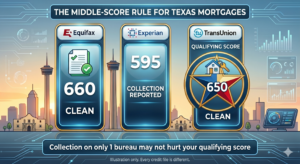
When you apply for a mortgage in Texas, lenders pull your credit score from all three bureaus (Equifax, Experian, TransUnion). They do NOT use the highest. They do NOT use the lowest. They use the MIDDLE score.
Here is what that means in practice:
- Equifax shows 660
- Experian shows 595 (where the collection is reported)
- TransUnion shows 650
Your qualifying mortgage score is 650 — the middle. Not the 595 with the collection.
Why this matters when you have collections
Collectors and creditors do not always report to all three bureaus. Many report to just one or two. If a collection only shows on Experian, it may pull that one score down — but if your other two bureau scores stay clean, your middle score might still be strong enough for a mortgage.
That is why one of the first things we look at on a free 3-bureau review is which bureau each collection is reporting to. Sometimes the strategy is not “dispute the collection” — it is “ignore it because it does not affect the qualifying score.”
This is the kind of thing you only learn after looking at thousands of credit files.
When to bring in The Credit Repairmen
You can read every guide on the internet, and you still might not know which type of collection you have, which bureau it is reporting to, or whether paying it off will help or hurt.
That is what we do.
You should reach out to The Credit Repairmen if:
- You have ANY collection on your report and a mortgage in your future
- You are not sure if your collection is medical, consumer, or federal
- You have multiple collections and do not know what order to handle them in
- You have already started paying a collection but want to know if it is helping or hurting
- You are worried about a possible CAIVRS hit from old student loans
- You see “consumer disputes this account” or duplicate collections on your report
- You have a 580 or higher score but cannot figure out why lenders are nervous
During your free 3-bureau credit report review, our team will:
- Pull or review all three of your credit reports with you
- Sort every collection by type, age, balance, and reporting bureau
- Tell you which ones to dispute, which to pay (and how), and which to leave alone
- Map out the right sequence so your moves help your score, not hurt it
- Coordinate timing with your mortgage application so nothing backfires
We were founded in 2011 by two former mortgage loan officers. We look at your credit through a lender’s eyes — not just a credit repair lens. That matters when you have collections and your goal is to close on a Texas home.
If you are below the 620 mark, also read our guide on buying a house in Texas with a 580 credit score — collections often hit harder when your score is already in the fair range.
For more on credit basics, browse our credit tips for Texas home buyers.
Yes, in many cases. Texas has a 4-year statute of limitations on most consumer debts — meaning a collector cannot sue you after 4 years. But a verbal promise to pay, partial payment, or written acknowledgment of the debt can restart that clock. If a collector calls about an old debt, do not agree to pay anything until you know how old the debt is and whether the statute has already passed. This is one of the most common ways consumers accidentally give up legal protections.
Mortgage lenders pull your credit score from all three bureaus and use the middle number — not the highest, not the lowest — as your qualifying score. This matters when you have collections because some collectors only report to one or two bureaus. A collection that lowers your Experian score may not affect your qualifying score if your Equifax and TransUnion scores are still strong. This is why looking at all three reports separately is critical when you have collections.
It depends on the type of collection and how it is reported. A settled collection still shows as a collection on your report, even if it shows a $0 balance. Paying in full does the same. The bigger move is negotiating removal of the account entirely, which is much harder to get in writing but sometimes possible. We strongly recommend talking to a professional before paying anything, because the wrong move can drop your score right when you need it strongest.
Yes. If you have a defaulted federal student loan, you will get flagged in CAIVRS — a federal database that blocks FHA, VA, and USDA loan approvals until the default is resolved. This can block your mortgage even if your credit score is 720 or higher. Conventional loans do not check CAIVRS, so that may be a workaround if your other numbers qualify. The federal Fresh Start program that cleared CAIVRS hits ended in October 2024, so most borrowers now need to go through loan rehabilitation or consolidation.
Usually not. Mortgage underwriters generally look past medical collections because medical debt is widely viewed as different from financial mismanagement. Modern FICO models heavily discount medical collections, and recent rules have removed many smaller medical collections from credit reports entirely. Larger, recent medical collections can still cause issues — but for most Texas buyers, an old medical collection is not the thing that will sink your loan.
No, you do not have to pay every collection before applying. In many cases, paying off a collection at the wrong time can actually hurt your score in the short term by updating the date of last activity. The right strategy depends on the type of collection, how old it is, the balance, and which bureaus it is reporting to. A free 3-bureau review tells you what to pay, what to dispute, and what to leave alone.
Still not sure where to start?
Call us — we'll review all 3 of your credit reports for free and walk you through exactly what needs to happen.
Call (210) 520-0444