


Texas First-Time Home Buyer Programs & Credit Score Requirements: 2026 Guide
Most first-time home buyers in Texas don’t need perfect credit to buy a home. Many loans work for buyers with credit scores around 620, and some Texas programs help buyers with lower scores if other parts of their file look strong.
So you’re thinking about buying your first home in Texas. Maybe you’re tired of throwing money at rent. Maybe your lease is up. Maybe you just got promoted and want to put down roots.
And then the worry kicks in — “is my credit score even high enough to do this?”
Here’s the truth most people don’t tell you: perfect credit is not required. In fact, plenty of Texans buy their first home with credit scores that would scare them if they only looked at the number.
This guide is your starting point. We’ll walk through:
- A simple credit score chart that shows where you stand
- What “first-time home buyer” actually means in Texas (it’s more flexible than you think)
- Every major Texas first-time buyer program with credit and income requirements
- What to do if you have no credit history, or if your spouse has bad credit
- Simple steps to move your score to the next band
The Texas first-time buyer credit score chart
Credit scores in the U.S. range from 300 to 850. The higher the number, the better. Here’s what each range means for a Texas first-time buyer:
- 300–579 (Poor): Most home loans will be hard to get. You may need to fix issues first.
- 580–619 (Fair): FHA loans usually work here. Some Texas programs may help too.
- 620–679 (Good): The sweet spot. Most Texas first-time buyer programs work at 620+.
- 680–739 (Very Good): Better rates and more loan options open up.
- 740+ (Excellent): Best rates, lowest payments, easiest approval.
If your score is 620 or higher, you can almost certainly buy—Texas first-time buyer programs often accept credit scores starting at 620. If you’re between 580–619, you have options. If you’re below 580, you’ll likely need to do some credit work first — but it’s usually fixable.
For a deeper breakdown of how scores affect loan costs and approval, see our guide on the credit score you need to buy a house in Texas.
What “first-time home buyer” actually means in Texas
This is the biggest myth in the room. Most people think “first-time buyer” means you’ve literally never owned a home in your life. That’s wrong.
In Texas, most programs define a first-time buyer as someone who has not owned a primary residence in the past three years.
So you qualify if:
- You’ve never owned a home (the obvious case)
- You owned a home years ago but have been renting for at least 3 years
- You’re a veteran (many programs waive the 3-year rule entirely)
- You’re buying in a “targeted area” (certain census tracts have expanded eligibility)
This matters. If you owned a condo in 2021 but have rented since 2022, you qualify in 2026.
And here’s a bonus: Understanding Texas first-time home buyer eligibility and program requirements shows that many Texas programs are also open to repeat buyers, not just first-timers. The label is just where most of the marketing focuses.
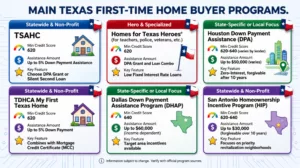
Texas first-time buyer programs and their score requirements
Texas has more first-time buyer help than most states. Here are the major programs as of 2026.
Statewide programs
These programs work anywhere in Texas.
TSAHC (Texas State Affordable Housing Corporation)
- Minimum credit score: 620
- Up to 5% down payment assistance (grant or forgivable loan)
- Two main programs: Home Sweet Texas (general) and Homes for Texas Heroes (teachers, first responders, veterans, EMS, corrections)
- Income limits vary by county
- Required homebuyer education course
TDHCA My First Texas Home
- Minimum credit score: 640 for FHA/VA/USDA loans, 620 for conventional
- Up to 5% down payment assistance
- 30-year fixed-rate loan
- Income and home price limits vary by county
My Choice Texas Home (also TDHCA)
- Open to repeat buyers, not just first-timers
- Higher income limits than My First Texas Home
- Same credit score requirements (640 FHA/VA/USDA, 620 conventional)
Mortgage Credit Certificate (MCC)
- Federal tax credit on mortgage interest paid each year
- Can be combined with down payment assistance
- Saves you money every year for the life of your loan
- Availability and rules change periodically — check with your lender
Texas Veterans Land Board (VLB)
- For Texas veterans
- Discounted interest rates
- Up to substantial loan amounts
- Can combine with other programs
City programs (extra help if you buy in these areas)
Many Texas cities offer their own assistance that can stack on top of state programs.
Houston — Up to $50,000 through the City of Houston Homebuyer Assistance Program. Forgivable loan if you live in the home for 5 years. Income limit: 80% area median income.
Dallas — Up to $60,000 through DHAP (Dallas Homebuyer Assistance Program). Forgivable second lien, no monthly payments. Income limit: 80% area median income.
Austin — Up to $40,000 through the Austin Down Payment Assistance Program. Helps cover down payment and closing costs.
San Antonio — Up to $30,000 through the city’s Homeownership Incentive Program. 0% interest, forgivable over 10 years.
Fort Worth — Up to $25,000 through Fort Worth’s Homebuyer Assistance Program.
Arlington — Up to $20,000 through Arlington’s program.
Harris County (outside Houston city limits) — Up to $25,000 through Harris County Community Services.
Tarrant County (outside Fort Worth) — Up to $50,000 through Tarrant County’s program.
Many smaller Texas cities also have programs. Call your city or county housing department to ask.
Stacking programs
Here’s the move most people miss: you can often combine state and city programs.
So a buyer in Houston could potentially layer TSAHC down payment assistance + Houston’s Homebuyer Assistance Program + a Mortgage Credit Certificate. Combined, that’s tens of thousands of dollars in help.
The catch — stacking programs takes a lender who’s approved for all of them. Most lenders are not. That’s why working with a lender or credit team that knows Texas programs cold matters more than the loan rate.
Ready to get back on track?
Get Your Free Credit AnalysisThe questions first-time buyers ask most
Every first-time buyer worries about something. Here are the ones we hear most often.
Do I need perfect credit to buy a home in Texas?
No. The minimum scores for the main loan types are:
- FHA loans: 580 with 3.5% down (some lenders go down to 500 with 10% down)
- VA loans: No official minimum, most Texas lenders want 580–620
- Conventional loans: Usually 620 minimum
- Most Texas first-time buyer programs: 620–640 minimum
If your score is in the 620s, you have lots of options. If it’s lower, you still have options, just fewer of them.
What if I have no credit history at all?
This actually happens often, especially with younger buyers who never opened credit cards or got financing for a car.
Your options:
- Manual underwriting — some lenders will manually review your file using alternative credit data like rent payments, utility bills, and insurance payments
- Build credit first — open a secured credit card, get a credit-builder loan, become an authorized user on a family member’s account. Many people can build a usable score in 6 months
- FHA loans with alternative credit — FHA specifically allows alternative credit history when no traditional score exists
If you have no credit, do NOT panic. You’re not blocked — you just need a slightly different path.
Will my spouse’s credit score affect my approval?
Sometimes yes, sometimes no.
- If both spouses are on the loan, lenders look at BOTH credit reports — and typically use the LOWER middle score as the qualifying score. So a high-credit spouse can be dragged down by a low-credit spouse.
- If only one spouse is on the loan, only that spouse’s credit is used. But the other spouse’s debts may still factor into your debt-to-income ratio in community property states like Texas.
In a lot of Texas marriages where one partner has bad credit, the stronger-credit spouse applies alone. It’s a legitimate strategy when it makes sense.
What if my partner has bad credit?
You have options:
- Apply for the mortgage in only one name (yours) if your income alone qualifies
- Work on improving the partner’s credit before applying together
- Use programs that allow non-occupant co-signers if you need extra income but want to avoid the credit drag
If your partner has a single bad item — like an old collection, charge-off, or even a recent late payment — that may be fixable. Sometimes a 60–90 day plan to address errors on a credit report can fix what looks like “bad credit” but is really just a few correctable items.
Can I buy a home in Texas if I owned one before?
Yes — if you haven’t owned a primary residence in the past 3 years, you qualify as a “first-time buyer” for most Texas programs. Veterans get this rule waived entirely.

How to move from where you are to where you need to be
Here’s a simple plan based on where your score lands today.
If you’re at 620 or higher
You’re ready to talk to a lender. Most Texas first-time buyer programs are open to you. Your next steps:
- Pull your three credit reports to see what’s on them
- Get pre-approved with a lender that knows Texas programs
- Take the required homebuyer education course (most TSAHC programs require one)
- Start house shopping with a real estate agent
If you’re at 580–619
You have options. FHA loans usually work here, and some Texas programs may still help. Your next steps:
- Pull your three credit reports and look for errors or quick wins
- Pay down credit card balances if you can — this is the fastest score booster
- Get a free credit review to see what’s pulling your score down
- Decide: apply now with FHA, or fix 30–50 points first to open up better options
If you’re below 580
Don’t panic, but don’t apply yet either. Most loan programs need at least 580. Your next steps:
- Get a free 3-bureau credit review to find out exactly what’s hurting your score
- Focus on the biggest fixable items first — errors, collections, late payments
- Build a 60–90 day plan to push your score above 580
- Avoid any new credit applications during this time
For tools to track your progress, we recommend CheckYourCreditReports.com. It pulls all three reports into one clean dashboard so you can actually see what’s moving and what’s not. Small monthly fee, but it makes the work much easier.
How a free 3-bureau review takes the mystery out of where you stand
If you’ve never seen your full credit report, you’re in good company — most first-time buyers haven’t either. A free review tells you in 24 to 48 hours:
- What’s actually on each of your three reports (they’re usually different)
- What’s likely hurting your score and what’s not as bad as you think
- Which loan programs and Texas first-time buyer programs you qualify for today
- What your realistic path looks like over the next 30 to 90 days
- Whether you should apply now or fix a few things first
We were founded in 2011 by two former mortgage loan officers. We’ve helped Texans in Houston, Dallas, San Antonio, Austin, and Fort Worth go from “is this even possible?” to keys in hand. We look at your credit through a lender’s eyes — which matters most when you’re a first-timer figuring this out for the first time.
If your score is in the 580 range, also check our guide on buying a house in Texas with a 580 credit score for the deeper breakdown.
For more on credit basics, browse our credit tips for Texas home buyers.
Ready to get back on track?
Get Your Free Credit AnalysisCommon questions about Texas first-time home buyer credit scores
Yes. Both TSAHC and TDHCA offer up to 5% down payment assistance as either a grant or a forgivable second lien. Most major Texas cities also have their own down payment assistance programs that can layer on top of state programs. Combined, qualifying buyers can sometimes get $25,000 to $60,000 or more in total assistance.
Yes. Most Texas first-time buyer programs define “first-time buyer” as someone who has not owned a primary residence in the past 3 years. So if you owned a home years ago but have been renting for at least 3 years, you qualify. Veterans typically have the 3-year rule waived entirely. Many programs are also open to repeat buyers, just with different income limits.
Most Texas state programs (TSAHC, TDHCA) require a minimum 620 credit score. TDHCA My First Texas Home requires 640 for FHA, VA, and USDA loans. If your score is below 620, you may still qualify for a standard FHA loan, but the down payment assistance programs typically require 620 or higher.
You still have options. Some lenders offer manual underwriting that uses alternative credit data like rent payments, utility bills, and insurance payments. FHA loans specifically allow this. You can also build credit fairly quickly with a secured credit card, a credit-builder loan, or becoming an authorized user on a family member’s account. Many people build a usable score within 6 months.
If both spouses are on the loan, lenders use the lower middle score between the two as the qualifying score. If only one spouse applies, only that person’s credit is used — but in community property states like Texas, the other spouse’s debts may still factor into the debt-to-income ratio. Many couples apply with just the higher-credit spouse when it makes sense.
No. Most Texas first-time buyer programs only require a 620 credit score. FHA loans can go as low as 580 with a 3.5% down payment, and some lenders accept 500 with 10% down. VA loans for qualifying military buyers often work in the 580 range. You do not need a 700+ score to become a Texas homeowner.
Still not sure where to start?
Call us — we'll review all 3 of your credit reports for free and walk you through exactly what needs to happen.
Call (210) 520-0444